The Show Was Never the Business

I want to tell you something the entertainment industry spent decades trying to hide, not intentionally, but because most people inside it never stopped long enough to see it clearly.
The show was never the business.
The show was always the vehicle.
I know this because I lived on both sides of it.
I spent years in and around Hollywood. Commercial actress. Producer. Someone who understood what it meant to compete for a $500 booking after driving across Los Angeles for a highly competitive audition, while watching SAG rates that used to command tens of thousands for a single national spot quietly collapse around them.
Why were those rates collapsing? Because a national spot on network television used to mean something specific: everyone was watching. The same channels. The same time slots. The same anchors.
Sponsors have always followed eyeballs. When the eyeballs started to scatter, the money followed. That part I understood early.
What took longer to articulate was why so many smart, talented people inside the industry couldn't see it happening.
What Show Business Was Actually Selling
Let me be clear about something, because I think this gets misread.
Being a news anchor is hard. Being a working reporter is hard. Being a professional actor is genuinely, technically difficult in ways that most people who haven't tried it don't fully appreciate. The people who built careers in traditional broadcasting and film earned them. The platform didn't manufacture its talent.
What the platform did was certify it.
Being on a real network, in front of a real camera, with real producers: that was society's proof mechanism. It said: this person has been vetted. This person has arrived somewhere most people can't go. The exclusivity was the product.
When the Proof Mechanism Cracked
And then COVID hit.
Suddenly, local and national news anchors were broadcasting from their living rooms. Guests appeared from spare bedrooms with bookshelves behind them and ring lights casting a faint glow on their faces. The production quality that people like me had spent careers perfecting disappeared, replaced by a grid of faces on a screen and whatever lighting someone could pull together in an afternoon.
And nobody turned it off.
The message still landed. The information still mattered. The audience stayed.
That moment cracked something open. The talent was still there. The illusion that the platform had made it real was not.
The Wild West Nobody Wanted to Name
Here is what nobody in the industry wanted to say out loud: we are now in the wild west of content creation.
The old measurement standards no longer apply. We are no longer judging from the benchmarks of Hollywood or traditional broadcast television. In this era, basic content often outperforms polished production. The more stripped down something is, the more people watch. Keeping attention has become its own discipline, completely separate from the craft that once defined quality.
And here is the part that I find genuinely interesting: in a world where everyone is producing content, the ones winning are the ones with the sharpest point of view. Thought leadership is the new exclusivity. If everyone is doing something, that's usually a signal to do something else.
The certification mechanism didn't disappear. It migrated.
And here's the impossible position that left most expert-led businesses in.
The shift from Hollywood standards to tech standards didn't make things easier. It created a new impossible standard. Now you're expected to produce content at the volume of a tech platform and the quality of a Hollywood studio, and do it yourself, and do it every day.
So Which Standard Do You Produce To?
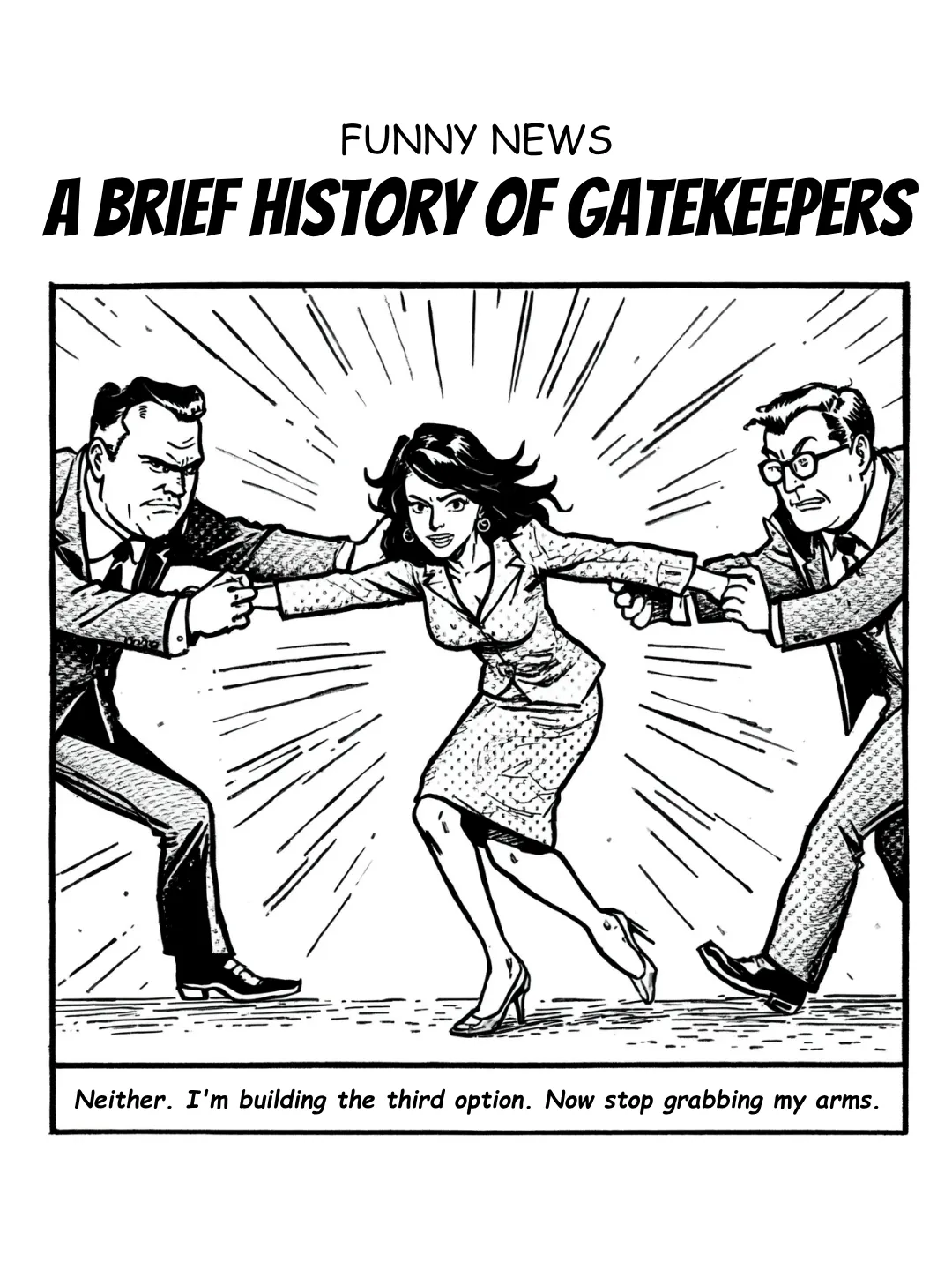
Hollywood said: high production, exclusive access, big budgets, long lead times. Tech said: volume, velocity, ship it fast, optimize later. Neither model was built for the founder who has real expertise, real clients, and a business to run.
Most expert-led businesses get stuck trying to do both and end up doing neither well. They either invest in beautiful content that nobody finds, or they produce a lot of content that doesn't reflect the depth of their expertise. The production question becomes the whole conversation when the distribution question is the one that actually determines whether any of it matters.
The answer isn't Hollywood standards or tech standards. It's human storytelling built on authority infrastructure. The show and the business. Finally unified for today's landscape.
That's the third option. And it's what CMarie Productions is built around.
The Identity Crisis Behind the Business Problem
What I watched people in Hollywood struggle with wasn't really a business problem. It was an identity crisis.
The question underneath everything was: who am I if anyone can do this?
If an influencer doing selfies in her car can build a larger audience than a seasoned network host with a full production budget and a team behind her, what does that mean? If a podcast recorded on a $100 microphone can outperform a talk show that's been on air for fifteen years, what exactly was the talk show selling?
Most people clung to the construct rather than question it. And I understand why. Your identity is in there. Your sense of worth is in there.
But some people saw it differently.
Gwyneth Paltrow built Goop. Jessica Alba built The Honest Company. Brook Burke and Maria Menounos built platforms that didn't require a network's permission to exist. What they understood, each in their own way, was that the audience was the actual asset. The platform was just a distribution channel.
And I want to say something specific about Gwyneth, because it goes beyond business strategy.
Harvey Weinstein was a gatekeeper for countless actresses. Access to opportunity, to roles, to careers ran through people like him. That's not ancient history. That's how the system functioned for decades. When you own your platform, when your audience and your income don't depend on anyone's approval to keep running, you remove that dependency entirely. That's not just a smart business decision. That's a different category of freedom.
What I Couldn't Keep Doing in Good Conscience
Now here is the part I don't often say publicly, but I think matters.
I was part of that system.
For years, I helped clients get on television. I believed in it. The work we did was genuinely good, and it genuinely helped people. There is still a demographic watching broadcast TV. Streaming platforms like Amazon and Netflix command enormous attention. Sports, especially global events like the World Cup, still draw eyeballs at a scale that very few platforms can match. I'm not saying traditional media is dead.
What I'm saying is that I watched the model shift underneath everyone's feet, and I reached a point where I couldn't in good conscience keep building my business on a foundation I watched changing in real time.
The realization didn't arrive all at once. It built slowly over the years, out of a specific frustration I kept running into with our production work.
We would produce excellent videos for clients. Genuinely excellent. And then watch them land in a vacuum.
The video was great. The distribution was an afterthought. And it wasn't until we started adding real strategy to where content was placed, how it was structured, and who it was built to reach, that results actually showed up for our clients.
Just having a cool video wasn't enough.
Some of the work we produced was never meant to be widely seen. It was built specifically for a client's existing audience to convert warm leads into buyers, and that worked exactly as intended. But cold traffic, reaching people who had never heard of our clients and turning them into believers, that was the problem we kept circling back to.
That's the nut we've been working to crack. And it's what the current model is built around.
The Same Shift Is Happening Right Now
Buyers aren't just Googling anymore.
They're opening ChatGPT, Perplexity, and Gemini and typing things like: "Who is the best estate planning attorney in Orange County?" or "What leadership coach do CEOs recommend for executive teams?" or "Who are the top executive recruiters for healthcare companies?"
And AI answers them. Confidently. With names.
Here's what that means for your business, and I want to be precise about this because it matters.
The businesses showing up in those answers aren't always the ones who've been around longest, or who have the deepest expertise, or who have the most client results sitting on their website. Some of them have simply, intentionally or not, built stronger authority infrastructure. More consistent positioning. Clearer expertise signals. Third-party validation that AI engines can read and trust.
That is a structural problem, and it will not correct itself.
The platforms have changed. The strategy has evolved. The commitment to making sure the right people get seen by the right audience has not. That work now lives at Curated Rank.
Cassandra Hein has produced talent in Hollywood for more than a decade, preparing founders and experts for TV. She started out producing and directing on-air talent at CBS/KPIX, and founded CMarie Productions in Hollywood in 2014. Her production credits include The Loud Silence on Fox Sports, a documentary on athlete mental health featuring Heisman Trophy winner and NFL quarterback Caleb Williams of the Chicago Bears and Destiny Littleton.
More about Cassandra